You’ve been going to the laundromat for years. Maybe it started when your apartment didn’t have in-unit machines. Maybe your washer broke, and you never replaced it. Maybe you moved to San Diego, and the laundromat on the corner was just there.
Now it’s routine. Every Saturday, or every other Sunday, you load up the car, drive over, spend two hours, and drive home. You have a system. You know which machines work best. You know not to use the dryer on the far left because it runs cold.
But somewhere in the back of your mind, you’ve been thinking: there has to be a better way to do this.
There is. When you switch from laundromat to laundry pickup and delivery, you trade a two-hour errand for a five-minute bag drop. Most people don’t make the move because the unknown feels riskier than the familiar inconvenience. You know exactly what the laundromat costs and how it works, even if you don’t love it. The pickup service is a question mark.
This article is here to remove the question marks. Not to sell you on switching. Just to tell you exactly what happens if you do.
You go to the booking platform and create an account. Takes about two minutes. You enter your address, pick a detergent (Freshly Folded offers Tide, Gain, All Free & Clear, 7th Generation, or Persil), and schedule your first pickup.
That’s it for the setup.
Before your pickup time, you bag your laundry. Any bag works. Garbage bags, duffel bags, laundry bags, old IKEA bags. As long as it’s sealed or tied shut and at your door when the driver arrives.
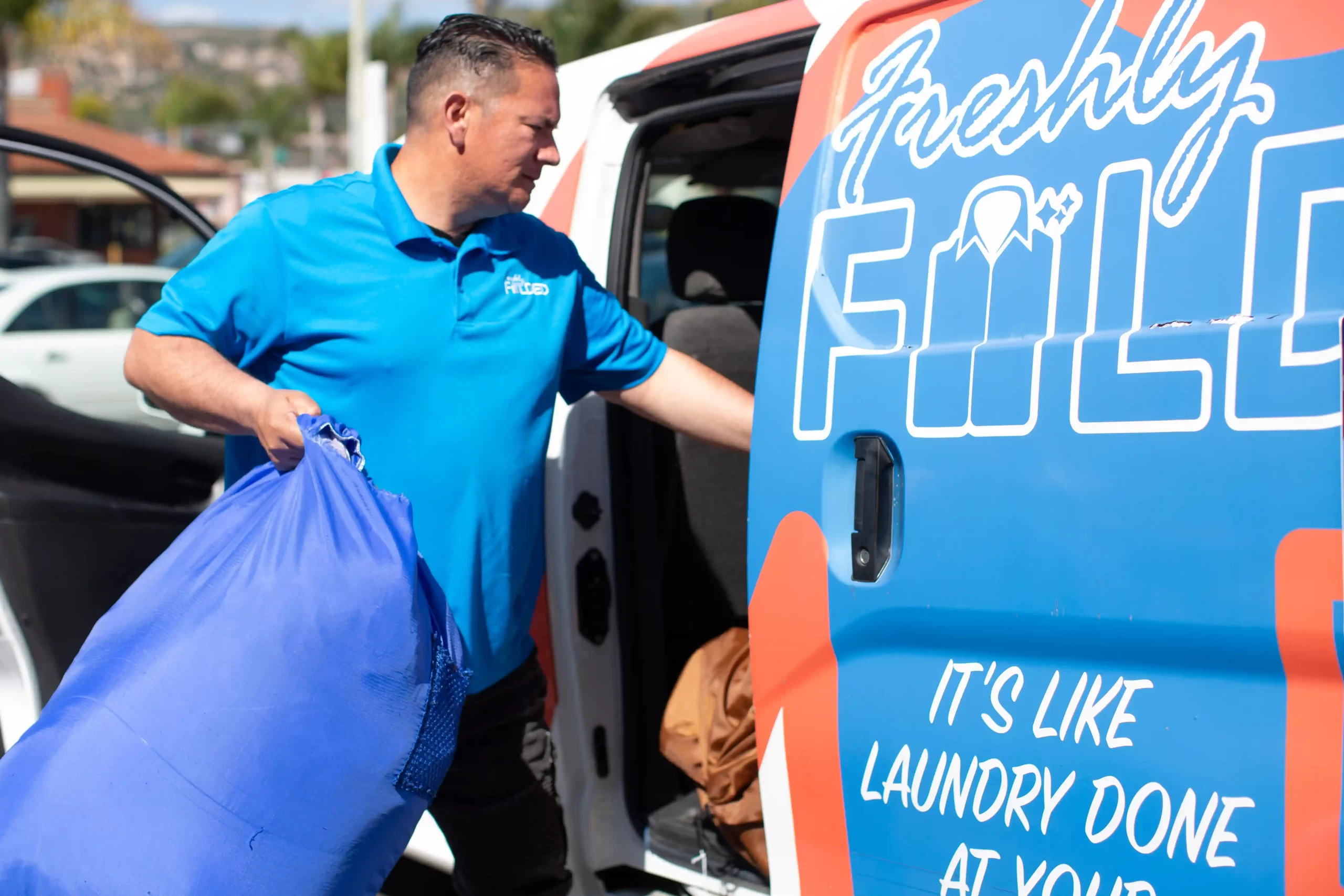
A driver picks it up during the service window. You don’t need to be home. You don’t need to hand it to anyone. It goes to Freshly Folded’s facility, gets washed with your chosen detergent, run through ozone sanitization, dried, and folded.
It comes back the next day. Clean. Folded. At your door.
When you switch from laundromat to laundry pickup and delivery, there’s a weird transition period that nobody warns you about. Here’s what it feels like.
Week one: You’re nervous. Did they get everything? Is it going to smell right? Will my favorite shirt survive? You check every item when it comes back. Everything’s fine. But you check anyway.
Week two: You start to relax. The clothes came back clean and well-folded. Better folded than you’ve ever done yourself, honestly. You notice the ozone-clean smell. Different from detergent-heavy. Cleaner.
Week three: You forget about it. You bag your laundry Monday morning, leave it at the door, and find it clean on the porch Tuesday afternoon. It’s just part of the week now. Like taking out the trash.
Week four: Saturday morning arrives. You don’t go to the laundromat. You sit on the couch reading, or go to the beach, or sleep in. You realize you have two extra hours that used to belong to washing machines and plastic chairs.
That’s the moment it clicks.
Let’s go through the real fears. Not the ones people post about online. The ones they actually think about.
Professional wash and fold services process hundreds of pounds of laundry per day. They have systems. Sort by color, sort by fabric weight, and check care labels. Commercial Maytag and Speed Queen machines handle clothes more gently than the beaten-up machines at most laundromats.
Could something go wrong? In theory, yes. The same way something could go wrong at the laundromat. But the odds are lower with professionals who do this full-time than with machines that haven’t been serviced since 2019.
If you have a specific item you’re worried about, leave a note. “This shirt is hand-wash only.” “Don’t dry the wool sweater.” Freshly Folded follows care label instructions and honors special requests.
This is the big one. You have a mental inventory of your wardrobe, and the idea of someone else handling it feels risky.
Here’s the reality: professional services use tagging and tracking systems. Your bag is logged when it arrives, processed as a unit, and returned as a unit. Items don’t get mixed with other customers’ loads.
Is the risk zero? No. But it’s not zero at the laundromat either. How many socks have you lost to the machines at your laundromat over the years? How many times has someone accidentally taken your clothes from a dryer?
This one’s more emotional than practical. Laundry feels personal. Your clothes, your towels, your sheets. Handing them to a stranger feels odd.
It felt odd the first time you used a car wash instead of washing your car in the driveway. Or the first time you hired someone to clean your apartment. Or the first time you ordered groceries for delivery instead of going to the store.
Every one of those transitions felt weird at first. Now they feel normal. Laundry pickup is the same.
Professional folding is better than what most people do at home. That’s not a dig. It’s just a fact. These are people who fold laundry eight hours a day. They’re fast and consistent.
If you have a specific preference (rolled towels instead of folded, shirts folded a certain way), you can include instructions. But most people find the professional folding is better than what they were doing on a wobbly table under fluorescent lights.
The laundromat vs delivery service debate always comes down to numbers, so here they are, the real ones, not cherry-picked to make pickup look good.
Expense | Cost |
|---|---|
Wash (2 loads × $4.00) | $8.00 |
Dry (2 loads × $2.50) | $5.00 |
Detergent | $1.00 – $3.00 |
Gas (round trip) | $3.00 – $6.00 |
Cash total | $17.00 – $22.00 |
Time (2 hours at $15/hr personal value) | $30.00 |
Total including time | $47.00 – $52.00 |
Expense | Cost |
|---|---|
25 lbs × $2.49 (weekly rate) | $62.25 |
Transport fee | $5.99 |
Total | $68.24 |
Time (5 minutes) | ~$1.25 |
Total including time | $69.49 |
In pure cash: the laundromat costs $17 to $22. Pickup costs $68.24. That’s a $46 to $51 difference.
When you add time value, the gap narrows to about $17 to $22.
And at higher time values ($25/hr, which is San Diego’s median wage), the gap disappears entirely.
The breakeven point is roughly $22 to $25 per hour in personal time value. If your time is worth more than that, pickup is cheaper in total cost. If it’s worth less, the laundromat saves money.
The time savings are the obvious thing. But there are a few less obvious benefits that laundromat regulars notice after switching to laundry pickup service.
No more quarter hoarding. You know the routine. Hitting up the bank for rolls of quarters. Keeping a jar of quarters on the dresser. Discovering you’re two quarters short when you’re already at the laundromat. Gone.
No more timing your life around laundry. The laundromat closes at 9 PM. Or it gets packed after 5 PM. Or the good machines are only available before 10 AM on weekends. With pickup, you schedule when it works for you and forget about it.
Your car stays clean. Hauling laundry bags in and out of your car gets old, especially when the bag is wet coming home because you couldn’t get all the wrinkles out and threw damp shirts in.
Better results. This one surprises people. Their clothes actually look and smell better from professional laundering than from the laundromat. Commercial machines with proper water levels, correct detergent amounts, and ozone sanitization produce noticeably better results than a coin-op machine that’s been running 18 hours a day for a decade.
Honesty is the whole point here, so before you stop going to the laundromat for good, here are the real downsides to weigh.
Control. At the laundromat, you choose the water temperature, the cycle length, how full to load the machine, and whether to add fabric softener. With pickup service, you choose the detergent and provide special instructions, but you’re not standing over the machine controlling every variable.
The social aspect. Some people actually like the laundromat. They chat with regulars. They watch the wall-mounted TV. It’s a break from their apartment. If the laundromat is part of your social routine, the pickup service removes that.
Immediate access. At the laundromat, your clothes are done in about 90 minutes. With pickup, turnaround is next-day. If you need something clean tonight, pickup doesn’t solve that.
The feeling of doing it yourself. There’s a satisfaction in handling your own laundry. Some people genuinely prefer it. That’s valid.
Freshly Folded has a $49.99 minimum order. At $2.49 per pound, that’s about 20 pounds.
If you’re a single person doing 12 to 15 pounds a week, you have a few options:
If your weekly laundry is genuinely under 10 pounds and you live alone, the minimum order makes pickup less practical for you. The laundromat or in-unit machines are a better fit.
Here’s the literal step-by-step:
There’s no contract. No commitment. No cancellation fee. If you try one pickup and decide the laundromat is better for you, cancel and go back. You’ve lost nothing except maybe $60 and the two hours you saved.
But here’s what actually happens for most people: they try one pickup, get their folded laundry back, realize how much time they wasted at the laundromat, and never go back.
Your Saturday mornings are about to get a lot better.
Can I switch back to the laundromat anytime?
Yes. There are no contracts, no commitments, and no cancellation fees with Freshly Folded. You schedule pickups only when you want them. If you decide after one or two pickups that you prefer the laundromat, just stop scheduling. Your account stays open with no charges unless you book a pickup.
How do I know my laundry won’t be mixed with someone else’s?
Each customer’s laundry is processed separately. Your bag is tagged and logged when it arrives at the facility and tracked through washing, drying, and folding. Your items stay together throughout the entire process and are returned in the same grouping. Items from different customers never share a machine cycle.
What kind of bag should I use?
Any bag that closes or can be tied shut. Heavy-duty garbage bags, reusable laundry bags, duffel bags, and large tote bags all work fine. Avoid paper bags that might tear when wet or open containers where items could fall out during transport. After your first pickup, you’ll figure out what size and type works best for your volume.
My laundromat is within walking distance. Is pickup still worth it?
The transportation savings are smaller if your laundromat is very close. But the time savings remain significant. Even if you live above a laundromat, you’re still spending 1.5 to 2 hours per session on the actual washing, drying, and folding. Pickup eliminates that time regardless of distance. Whether the cost difference is worth it depends on how you value those hours.
What happens to items with special care instructions?
Include a note with your pickup detailing any special requirements. Items tagged as hand-wash-only, air-dry, cold-water-only, or any other specific care instruction will be handled according to those labels. If you have something extremely delicate or valuable, you can also choose to keep those items out of the pickup bag and hand-wash them yourself while the service handles everything else.